
Inpatient Rehabilitation Unit
The Inpatient Rehabilitation Unit at Boone Health is a dedicated hospital unit that provides intensive medical and rehabilitative care. It is designed for patients recovering from major surgeries, injuries or debilitating illness who need physician oversight and rigorous interdisciplinary therapy to regain independence. The unit must follow regulatory standards established by The Centers for Medicare and Medicaid Services (CMS) and the Joint Commission. These regulations govern which diagnoses that can be admitted, the medical services provided, the intensity and frequency of therapy services provided and the length of time the patient can stay on the unit.
The Inpatient Rehab Unit includes 15 beds and primarily serves patients who are transitioning from acute level of hospital care (short-term hospital stay), but are not yet ready to return home. Although many admission referrals come directly from Boone Health, the Inpatient Rehab Unit can also look at referrals that come from outside hospitals, a primary care physician or skilled nursing facilities.
Because inpatient rehab is highly regulated, patients must meet strict criteria related to medical complexity, therapy need and the ability to tolerate the intensity of the rehab program. Patients admitted to the unit generally must be able to tolerate three hours of therapy per day, over five days of the week. They also must require the need of at least two of the therapy disciplines, one of which must be physical therapy or occupational therapy.
Common diagnoses for the inpatient rehabilitation unit includes stroke, spinal cord dysfunction, amputation, hip fractures and post-surgical conditions.
Patients will have the need for 24/7 nursing care and will also require close physician supervision for medical management. This level of structure, intensity and collaboration is not available on acute care units or skilled nursing facilities.
The unit operates with a fully integrated care team that includes:
Medical Director
Licensed RN
Patient Care Technician
Social Worker
Physical Therapy/Occupational Therapy/Speech Therapy
Dietary Service
Every discipline plays a critical role, from documenting nutritional intake to coordinating equipment and follow up services at discharge.
The process for admission to the inpatient rehab unit begins with evaluations of the patient while they are still in the acute phase of the hospital. Patients who may benefit from inpatient rehab are referred to the clinical liaison. The liaison will review the patient’s medical history, their acute therapy notes and work with insurances to determine whether the patient meets admission criteria.
Once the patient is admitted to the inpatient rehabilitation unit, evaluations are completed by the care team. Goals are established for the patient, and the team works together to coordinate a plan to support the patient’s recovery while they work towards their goals.
The inpatient rehabilitation unit addresses not only physical recovery but also emotional, psychological and educational needs of the patient as well. Patients often struggle with tasks they once took for granted and small milestones may not always seem that big. The team helps patients recognize progress and stay motivated.
Inpatient rehabilitation provides patients with the time and resources needed to regain independence and safely return to their home or next level of care. The average length of stay is approximately 13 days with most patients discharging to their home independently or with family.
Janell’s Inpatient Rehab Story
Janell Tallmage had good looking legs growing up. All her teachers at school would tell her, “You have the prettiest legs!” She thinks about that at times now and tells herself, “Well, you had them for 74 years, so that’s pretty darn good.”
Underneath the beautiful legs, Janell inherited something far less kind: a difficult vascular system. Her father and grandfather both struggled with vascular disease, and over time, Janell developed the same problems. Poor circulation in her legs gradually worsened, leading to pain, weakness and eventually severe blockages. She was diagnosed with peripheral arterial disease (PAD), a condition where plaque buildup narrows the arteries and restricts blood flow to the limbs.
Janell’s vascular journey has included femoral artery occlusion (a blockage in the main artery supplying blood to the leg), multiple femoral-anterior tibial artery bypasses (surgeries to reroute blood flow around blockages), and repeated blockages and narrowing of arteries.
Despite multiple interventions, Janell’s circulation continued to decline. Eventually, both legs reached a point where blood flow could not be restored.
Janell had been a patient of Erica Salinas, MD, at Boone Health Vascular Surgery and had been to the office many times to manage her symptoms. During one appointment in September 2025, Dr. Salinas had Janell admitted to the hospital for further testing. The results showed no meaningful perfusion, meaning Janell’s right leg had become mottled and purple, a sign that tissue in her leg was dying. The only option to save Janell’s life was to amputate her right leg.
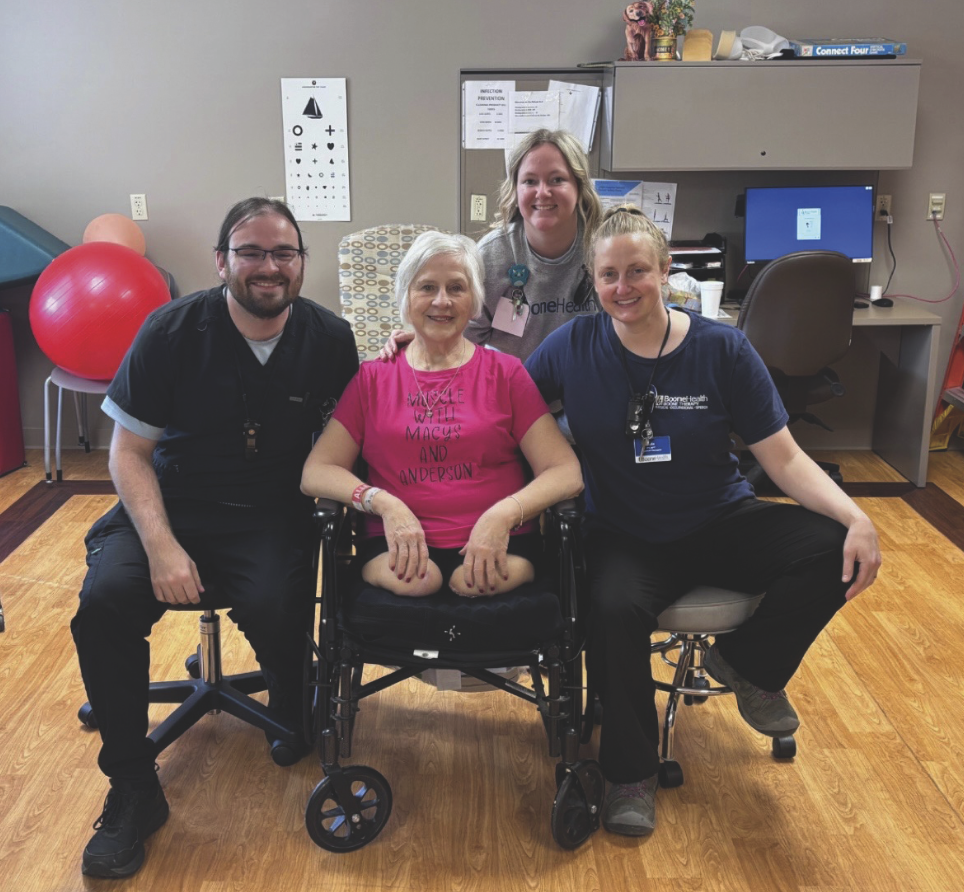
Janell spent two weeks in the inpatient rehabilitation unit after her first amputation. Her physical and occupational therapists taught her how to adapt to life with one leg, how to strengthen her remaining limb, how to move safely, and how to regain independence.
Despite her best efforts, in early 2026, Janell’s left leg began to fail as well. She developed ischemia, meaning the leg was no longer receiving enough blood to survive. In May 2026, the decision was made to amputate her left leg as well.
This time, Janell spent three weeks in rehab. The first time on the unit, Janell shares she was pretty nervous, but the second time around, she knew she was returning to a team of caregivers that made her feel like part of the family.
With both legs removed above the knee, Janell’s team had a new set of goals for her: learning to roll over, balance while seated, transferring in and out of bed, moving safely to and from her wheelchair, and managing toileting independently.
“Everything they had me do was just to get stronger. To learn how to do things on my own,” Janell said.
Sleeping by her side in the hospital recliner most nights was her husband Donnal “Bosco”. Janell and Bosco have been together since she was 15 and he was 17. She recalls how he used to call her every Wednesday night after she returned home from choir practice at church. “He was so good looking, and sweet,” Janell said, “and he had the best blue eyes and smile.” Now, 57 years later, he’s still by her side while they navigate this new normal.
Thinking back to the care she received in Inpatient Rehab, Janell shares through tears, “I couldn’t have had a better group of people taking care of me.”
By Erin Wegner