
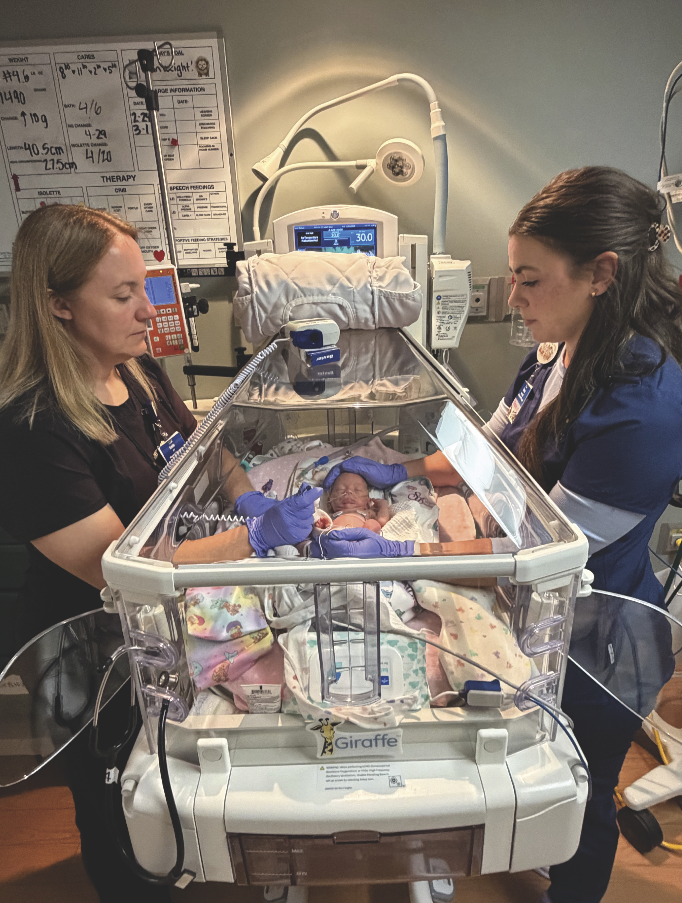
Tiny Patients, Powerful Progress
Inside the NICU Therapy Team
In the quiet, carefully controlled environment of a Neonatal Intensive Care Unit (NICU), some of the smallest patients receive some of the most specialized care. Beyond the monitors, incubators, and medical interventions, there’s a team working hands-on to support development from the very beginning—therapy specialists who help fragile infants grow, regulate, and thrive.
“We have physical therapy, occupational therapy, and speech therapy in the NICU,” explains Katie Goodlet, PT. “We provide direct patient care and consultative services to premature and medically complex infants. Our overall goal is to provide integrated, neuroprotective, and family-centered care that supports optimal long-term development.”
Therapy in the NICU is an interprofessional collaborative practice that incorporates theories and scopes of practice from all three respective disciplines. Each therapy discipline plays a distinct but highly collaborative role in supporting an infant’s development:
Physical Therapy (PT) focuses on movement, strength, and positioning. PTs help infants develop proper muscle tone and motor patterns, guiding how they move, stretch, and build early physical skills. They also assist with positioning to promote comfort, symmetry, and healthy development.
Occupational Therapy (OT) centers on sensory development, regulation, and daily care activities. OTs help babies tolerate touch, movement, and environmental stimuli while supporting skills like feeding readiness, calming techniques, and bonding. They also coach parents on how to safely handle, hold, and interact with their baby.
Speech Therapy (SLP) in the NICU focuses primarily on feeding and swallowing. Speech-language pathologists assess an infant’s ability to safely coordinate sucking, swallowing, and breathing—critical skills for successful feeding. They also support early communication development and oral motor function.
“Babies are miracles. I love being able to provide input that may make their sweet lives less stressful,” said Sarah Glass, SLP. “Educating and empowering parents regarding something as precious and bonding as feeding is enough to make anyone’s day. I feel like I’ve won the lottery most days I come to work.”
That same compassionate, patient-centered approach is shared across the entire therapy team.
“For babies who need more calming and containment, therapy can be that extra set of hands,” said Emma Ploof, OT. “We work to keep the baby as calm as possible by decreasing stimulation—extra noise, bright lights, changes in temperature, excessive movement—which helps protect their brain development.”
And therapy in the NICU isn’t only about minimizing stress—it’s also about encouraging growth. Therapists work together to guide positioning, feeding, bathing, hydrotherapy, massage, and gentle movement exercises tailored to each infant’s needs.
“We’re constantly assessing how the baby responds—looking at movement patterns, reflexes, and tolerance to touch,” Ploof explains.
Just as important as hands-on care is education and collaboration. Therapists work closely with nurses, physicians, and respiratory teams, while also empowering parents to feel confident in caring for their baby.
“Parents are present and included in treatment sessions as much as possible, so they feel empowered and comfortable caring for their infant,” Ploof adds.
Care doesn’t stop at discharge. For many babies, especially those born before 33 weeks or with complex medical histories, support continues through developmental clinics and specialized outpatient programs at Boone Therapy.
“Our developmental clinic follows infants to monitor milestones and address any concerns,” says Goodlet. “We do developmental testing and make recommendations for additional services if needed.”
This continuity ensures that early interventions in the NICU carry forward into the critical early years of life, giving children the best chance to meet developmental milestones and thrive.
While the work is highly specialized and requires extensive training, the therapists agree that the rewards are immeasurable.
“Watching development that would normally happen in utero happen right before our eyes is so neat,” says Goodlet. “We get to see these tiny babies develop personalities and follow them until age three—it’s incredibly rewarding.”
For many therapists, the connection with families lasts far beyond the NICU stay.
“Families I’ve known for over 20 years still give me updates,” she shares. “These tiny infants are now thriving as young adults.”
Working in the NICU isn’t something therapists step into overnight. It requires advanced training, mentorship, and a deep commitment to both clinical excellence and compassionate care.
“The NICU is an advanced practice specialty,” Goodlet emphasizes. “It takes time and patience to get here—but it’s the best job ever.”
In a place where every ounce matters and every milestone is hard-won, NICU therapists provide something invaluable: steady hands, expert care, and hope for the future—one tiny patient at a time. By Madison Loethen