
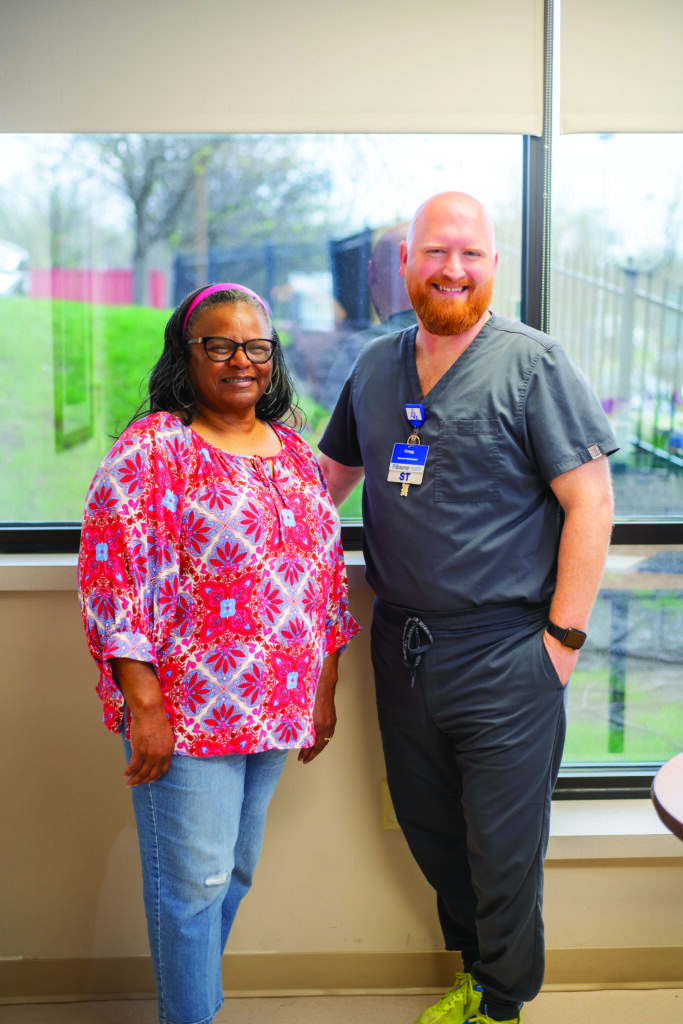
VOICE THERAPY
Gregg’s passion for the voice has brought voice therapy to Boone Health
Music has always been central to Gregg Anderson’s life. His love for singing began with a strong family foundation – everyone in his family was musical. He recalls childhood Friday nights playing on the kitchen floor while his parents and friends rehearsed a cappella quartet music. Both sets of grandparents also sang and played instruments, exposing him early to a wide range of styles. Family road trips were filled with the sounds of his parents’ favorite artists—including The Carpenters, John Denver, Simon & Garfunkel, Merle Haggard, Don McLean, and The Beach Boys—and it wasn’t long before he began picking out melodies and harmonies.
Throughout his youth, Gregg sang in church and joined school choirs. By high school, he participated in every ensemble available – choirs, quartets, musicals, praise bands, and even garage bands. Studying music in college felt inevitable.
At Andrews University, Gregg majored in vocal performance, planning to sing professionally or teach music like his father. However, during required lessons with Professor Stephen Zork, Gregg was introduced to the science of the voice. In his studio, Professor Zork introduced a highly tactile, anatomical, and physiological approach to voice production. These techniques were easy for Gregg to understand and reproduce, sparking a deep interest in the science of voice function, or vocology.
Gregg began reading extensively about laryngeal anatomy and the vocal fold function. This research led him to stories of professional singers—such as Julie Andrews, Luciano Pavarotti, and Steven Tyler—who had struggled with vocal nodules, polyps, and cysts, which significantly impacted their careers. This led him to discover speech-language pathology and the healthcare professionals who rehabilitate professional voice users through therapy. Captivated, he shifted his academic path toward helping people with voice disorders (dysphonia).
Gregg joined Boone Outpatient Therapy in March 2025, and has been treating patients with voice and upper airway issues, as well as swallowing, speech, language, and cognitive-linguistic difficulties. His passion, however, remains working with the voice.
What Is Speech Therapy?
Speech therapy addresses communication disorders involving speech production, language and cognition. Speech-language pathologists (SLPs) help individuals with challenges ranging from lisps or stuttering in children to post-stroke communication difficulties. They also help people with cognitive abilities like attention/concentration, short term memory, safety awareness, or problem solving. SLPs also provide assessment and treatment for difficulties with swallowing, particularly after a stroke, neck surgery, tongue/throat surgery, and/or throat cancer. This therapy focuses on rebuilding strength and coordination so patients can eat and drink safely and more comfortably.
Where Does Voice Therapy Fit In?
The voice is a vital component of verbal communication, providing the sound—or phonation—before speech is ever formed by the tongue and lips. Phonation occurs when air passes through the vocal folds, causing them to vibrate. This sound then travels through the throat, mouth, and nose, where articulatory structures shape it into speech. Like any part of this complex system, the voice is susceptible to disorders, clinically known as dysphonia.
Dysphonia often develops slowly over months or years. “People often live with voice problems until it becomes bothersome or begins to negatively impact communication,” Gregg notes. At that point, patients are typically referred to an ENT (Ear, Nose, and Throat) physician or a speech-language pathologist.
Dysphonia can stem from many causes: a paralyzed vocal fold after thyroid surgery, nodules from overuse, vocal fold atrophy, or muscle tension. Regardless of the cause, voice therapy focuses on rehabilitating the vocal mechanism and improving its overall efficiency.
“Many people don’t realize voice therapy exists,” Gregg said. “Unlike singing lessons, therapy focuses on educating patients about laryngeal anatomy, increasing awareness of vocal fold function, maximizing breath support, and using resonance to project the voice without strain.”
Gregg frequently uses Resonant Voice Therapy (RVT), which uses semi-occluded vocal tract exercises (SOVTEs)—such as humming, lip trills, or blowing bubbles through a straw—to produce speech sounds felt at the front of the mouth. “This shifts the feeling of the voice forward and out of the throat,” Gregg explains. “If the voice is stuck back there due to compensatory muscle strain, it muffles the sound, which often causes the speaker to strain even harder for volume.”
Lue’s Journey
Lue Lockridge-Lane is a minister and preacher for several central Missouri churches and regularly performs as a vocal soloist. She was referred to Gregg for voice and upper airway therapy by her pulmonologist to address possible vocal cord dysfunction, an airway disorder involving vocal fold spasms and closure.
Lue had been experiencing episodes of shortness of breath, especially while speaking and singing, along with hoarseness, strain, and reduced vocal range for nearly a year. Her pulmonologist ruled out pulmonary causes aside from her allergies and asthma.
“I used to be a soprano,” Lue said, “But I would feel tiredness in my throat, I couldn’t breathe when singing or speaking and sometimes got dizzy. It made me afraid of reaching my higher register.” With weekly singing, biweekly preaching and frequent meetings, her high vocal demands, combined with her asthma, allergies, and a viral infection
all led up to her throat spasms and
voice changes.
In early sessions, Gregg taught Lue open airway breathing strategies and exercises to reduce laryngeal tension. He then helped her shift her voice out of the back of her throat and into the front of her mouth, releasing strain. They are now working on applying these techniques to both speech and singing.
“This has been great for her range,” Gregg said. “She struggles with higher notes, and we’ve been addressing that at different levels. She’s learned to keep that forward feeling in her mouth and nose and has trained her throat, body and breath to be in coordination, and she’s really found it to be successful.”
Working with Gregg gave Lue the awareness of the problem of throat tension, why it was happening, and how she can learn to control it with tools and strategies. “It’s like someone turned on a light bulb for me,” Lue said. “Gregg’s shown me things I can do myself to help strengthen my voice and things I can do to evaluate some of the other pressures in how I was using my voice.”
Lue shares, “Gregg was able to understand and address the concerns I expressed, which truly impressed me. I looked forward to reading his notes in my patient portal, because they often provided an even deeper understanding of our discussions. His documentation helped clarify where I was in my treatment journey, why certain approaches were being used, and showed the progress I’d made along the way. Before working with Gregg, I was hesitant to use my higher vocal register. Now, I use it regularly and with confidence. The growth I’ve experienced has been remarkable, and the transformation has been nothing short of life changing.”
By Erin Wegner